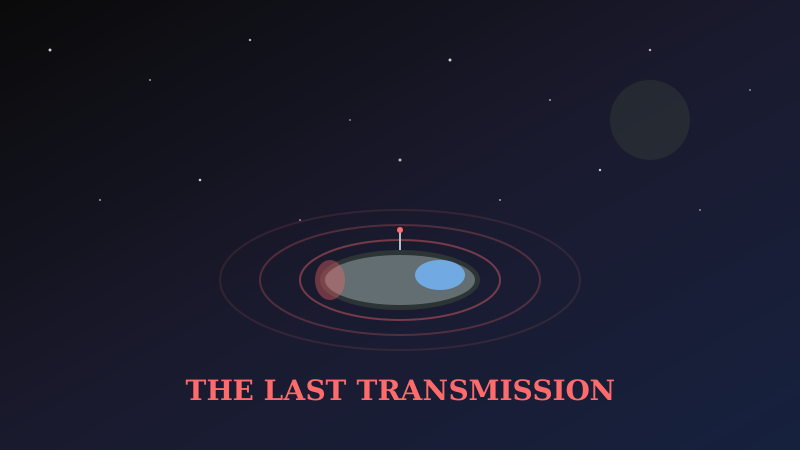
The Last Transmission
Part I: The Signal
Commander Elena Vance had grown accustomed to the silence of deep space. Three months into her solo survey mission to the Kepler-442 system, the quiet had become almost comforting—a familiar companion in the endless void between stars.
She was reviewing spectrographic data when the communication array chirped.
Elena froze. Her fingers hovered over the console. The Proxima was equipped with the latest quantum entanglement communication system, but she wasn’t scheduled for a check-in for another forty-eight hours. Besides, the tone was wrong—this wasn’t the syncopated rhythm of a standard transmission, but something rawer, more urgent.
The signal originated from approximately two light-years away, in a sector that should have been empty.
“This is the UNS Avalon, designation November-Uniform-Sierra-Four-Two-Niner. If anyone receives this transmission, we are stranded in grid reference K-774.1. Our quantum drive failed during the jump to Proxima Centauri. Life support at twenty-three percent. Please, if anyone hears this—”
The voice cut off, replaced by static.
Elena’s heart hammered against her ribs. She knew that ship designation. Everyone did. The UNS Avalon had been the pride of the United Nations Spacefleet, the first vessel equipped with an experimental quantum displacement drive. It had launched twenty years ago, bound for Proxima Centauri, and vanished without a trace.
Twenty years ago.
And yet, here was its distress call, fresh as morning, originating from a location barely two light-years from her current position.
Part II: The Decision
Elena spent three hours analyzing the transmission. She checked her equipment, ran diagnostics, verified her position against stellar landmarks. Everything confirmed what her instruments told her: the signal was real, it was recent, and it was impossibly close.
The Avalon had been gone for two decades. Its crew—four hundred men and women—had been declared lost, presumed dead. Memorials had been erected. Children had been born who would never know their parents.
And now, suddenly, it was calling for help.
She could report it to Central Command, of course. Wait for instructions. But that would take four years for a signal to reach Earth and a response to return. By then, if the Avalon’s life support was truly at twenty-three percent, everyone aboard would be long dead.
Or she could alter course and investigate herself.
Elena stared at the starfield displayed on her viewport. The Proxima was a survey vessel, not a rescue ship. She had minimal medical supplies, limited spare parts, and a mission timeline that didn’t account for detours. But she also had functioning quantum drives and enough fuel to reach the Avalon’s coordinates and return to her original trajectory.
“Commander Vance,” she said, addressing her log recorder. “I am deviating from mission parameters to investigate an anomalous distress signal. UNS Avalon, presumed lost twenty years ago. Coordinates attached. If I don’t make my next scheduled check-in… tell them I had to try.”
She engaged the drives.
Part III: The Wreck
The Avalon was beautiful.
Even damaged, even drifting, even wrong in ways Elena couldn’t quite articulate, the ship was beautiful. Its hull gleamed in the distant light of a red dwarf star, the experimental quantum rings still intact around its midsection like silver halos.
But it was also impossible.
Elena had studied the Avalon in academy. She knew its specifications, its history, its fate. The ship that floated before her now looked pristine—no signs of twenty years of micrometeorite impacts, no radiation scoring, no degradation of its solar panels.
It looked as if it had launched yesterday.
“UNS Avalon, this is Commander Elena Vance of the UNS Proxima. I have received your distress call. Please respond.”
Silence.
She tried again on every frequency, every emergency channel, every band that might conceivably carry a signal. Nothing. The Avalon was a ghost ship, all lights dark, all systems apparently offline.
Except for one.
As Elena maneuvered the Proxima closer, matching the Avalon’s gentle drift, she noticed a single viewport on the bridge deck. Through the thick transparent aluminum, she could see a light. Faint, flickering, but definitely there.
Someone was home.
Part IV: The Boarding
Elena had never boarded a derelict vessel before. The training simulations made it seem straightforward: suit up, tether in, float across the gap, find an airlock. Reality was messier. The Avalon’s exterior was covered in a fine layer of ice—sublimated atmosphere, her suit’s computer suggested—and her magnetic boots slipped twice before she found solid purchase.
The airlock cycled open with surprising ease, as if the ship had been waiting for her. Inside, the atmosphere was breathable but stale, smelling of ozone and old copper.
“Hello?” Her voice sounded strange in the empty corridor, too loud and too small at once. “This is Commander Elena Vance. I’m responding to your distress call. Is anyone aboard?”
The ship answered with silence and the gentle hum of dormant machinery.
She made her way toward the bridge, guided by memory of the Avalon’s deck plans and the faint light she’d seen from outside. The corridors were eerily intact—no signs of struggle, no debris, no bodies. It was as if the crew had simply vanished, leaving behind their coffee cups, their half-finished crossword puzzles, their photographs of Earth.
The bridge door was sealed, but the emergency release responded to her touch. It slid open with a pneumatic sigh, revealing…
Captain James Morrison sat in his command chair, exactly where he should have been.
He was dead, of course. Elena knew that immediately, even before her suit’s medical scanner confirmed it. He had been dead for a very long time. But his body was perfectly preserved, his hands still resting on the armrests, his eyes closed as if in peaceful sleep.
And on the main viewscreen, the distress signal continued to play on loop, his voice calling out across the void:
“This is the UNS Avalon… life support at twenty-three percent… please, if anyone hears this—”
Part V: The Truth
Elena spent six hours aboard the Avalon, and in that time, she pieced together a story that would haunt her for the rest of her life.
The quantum displacement drive had worked—after a fashion. Instead of instantly transporting the Avalon to Proxima Centauri as intended, it had created a temporal anomaly. The ship had been trapped in a bubble of localized time, moving at a fraction of normal speed relative to the outside universe.
For the crew, only three weeks had passed. For the rest of humanity, twenty years.
They had tried to repair the drive, of course. They had sent distress calls, watched their life support dwindle, held each other as hope faded. One by one, they had succumbed to the inevitable—malnutrition, hypoxia, despair.
Captain Morrison had been the last to go. His final log entry, recorded in a voice hoarse with thirst, explained everything. He had ordered the distress beacon to transmit on a rotating schedule, hoping that someday, somehow, someone might hear it.
What he couldn’t have known was that time outside the anomaly moved differently. By the time his signal reached Elena, it had been traveling for twenty years. By the time she responded and reached the Avalon, another six months had passed in the outside world.
But inside the bubble, only minutes had elapsed.
Elena found the timestamp on the distress beacon’s final transmission. It had been sent seventeen minutes ago.
Seventeen minutes, by the Avalon’s internal clock.
If she had arrived sooner—if she had turned immediately instead of analyzing the signal for three hours—she might have found them alive. She might have saved them. Four hundred people, and she had missed them by seventeen minutes.
Epilogue: The Transmission
Elena buried the crew in space, one by one, recording their names and faces for the memorial that would inevitably follow. She salvaged the Avalon’s logs, its experimental data, Captain Morrison’s final message to his family.
And then she did something she wasn’t supposed to do.
She reset the distress beacon.
Not to call for help—there was no one left to save. But to send a message backward through time, to the Elena who had first heard the signal, to tell her what she would find and what she would miss.
“Don’t hesitate,” she recorded. “They have seventeen minutes left. Seventeen minutes, and you can save them all. Turn around. Turn around now.”
She set the beacon to transmit on the same frequency where she had first heard the Avalon’s call, targeting the temporal coordinates where her past self sat analyzing spectrographic data, three hours ago and twenty years from now.
Then she disengaged the magnetic tether and watched the Avalon drift away, its silver rings catching the starlight, its beacon calling out across time for a rescue that had already failed.
Some transmissions, Elena realized, were never meant to be answered. They were just echoes of hope, bouncing through the dark, reminding us that in the vastness of space, we are never truly alone—even in our final moments.
She turned the Proxima toward home, and tried not to listen for the sound of her own voice, calling out from the past.
End of Transmission